If you are searching for the iPhone 17 because you are planning to buy a new iPhone, or if you simply want to know what Apple has changed this time, you have come to the right place.
iPhone 17 Specifications
| Feature | iPhone 17 | Details |
|---|---|---|
| Display | 6.3-inch OLED | Super Retina XDR, ProMotion up to 120Hz |
| Resolution | 2622 × 1206 | 460 ppi |
| Processor | Apple A19 | 6-core CPU, 5-core GPU |
| Rear Camera | 48MP Dual Fusion | Main + Ultra Wide |
| Front Camera | 18MP | Center Stage |
| Storage | 256GB / 512GB | Two storage options |
| Battery | Up to 30 hours | Video playback |
| Fast Charging | Up to 50% in 20 minutes | With compatible 40W adapter or higher |
| Connectivity | 5G, Wi-Fi 7 | Bluetooth 6 |
| Port | USB-C | USB 2 data speeds |
| Water Resistance | IP68 | Water and dust resistance |
| Weight | 177g | Aluminium design |
| Colours | 5 options | Black, White, Mist Blue, Sage, Lavender |
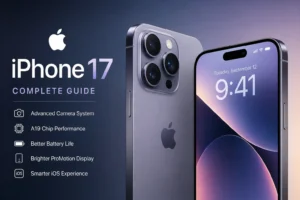
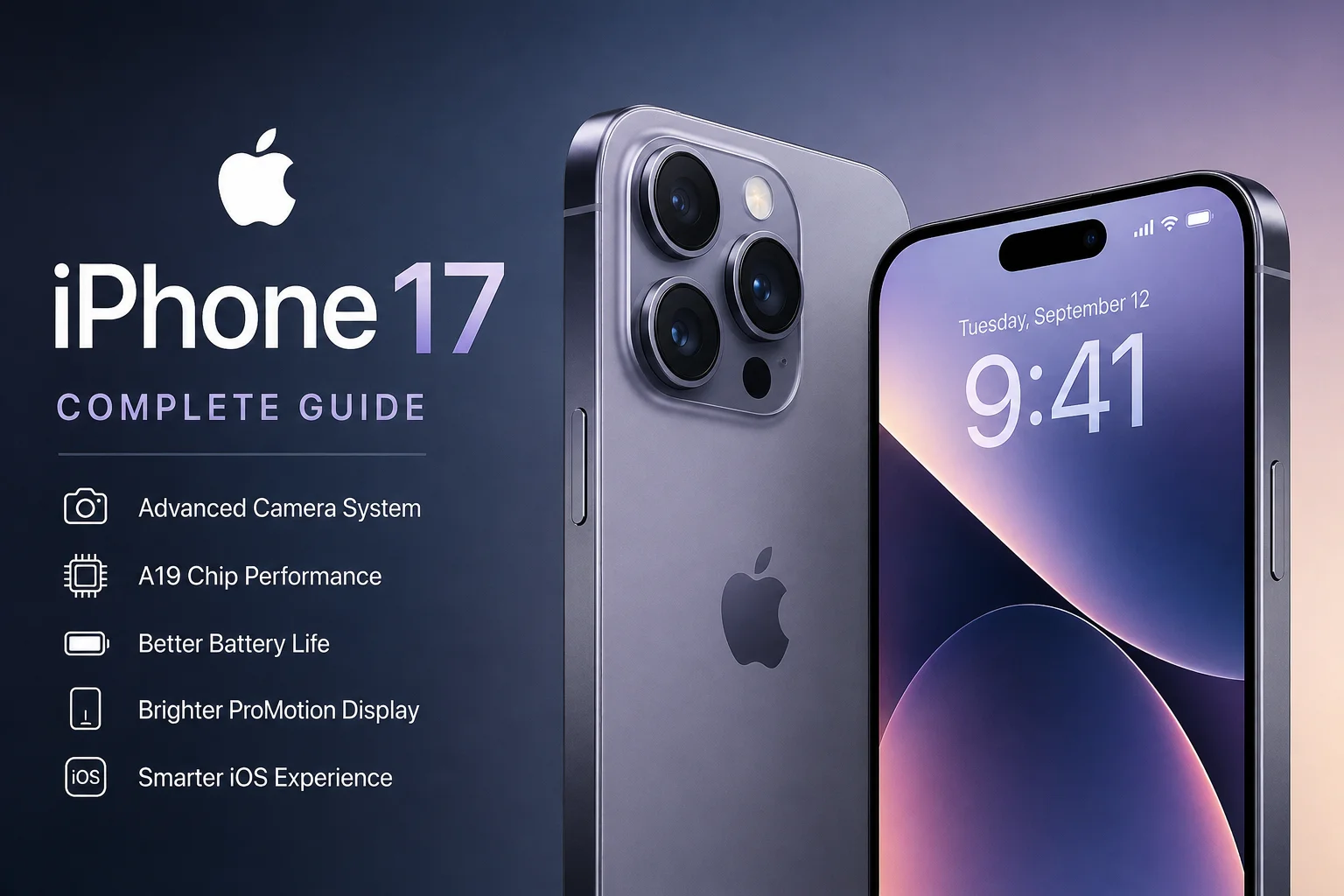
The iPhone 17 brings several upgrades that are actually noticeable in everyday use. The biggest one is the new 6.3-inch ProMotion display with a refresh rate of up to 120Hz. Apple has also added the A19 chip, a new 48MP Dual Fusion camera system, an 18MP Center Stage front camera, larger starting storage and faster charging.
On paper, these sound like typical yearly improvements. But what do they actually mean when you use the phone every day?
Does the 120Hz display really make a difference? Is the camera better for normal photography? How powerful is the A19 chip? And can the battery comfortably last through a full day?
Let’s take a closer look at the iPhone 17 and see what you actually get.
iPhone 17: Quick Overview
The iPhone 17 is Apple’s standard iPhone model, sitting below the iPhone 17 Pro and iPhone 17 Pro Max.
It has a 6.3-inch Super Retina XDR OLED display with ProMotion, Apple’s A19 chip, a 48MP Dual Fusion rear camera system and an 18MP Center Stage front camera.
Storage starts at 256GB and goes up to 512GB.
The phone is available in five colours: Black, White, Mist Blue, Sage and Lavender.
It also uses an aluminium design with Ceramic Shield 2 on the front and has an IP68 rating for water and dust resistance.
That gives you a quick idea of what Apple is offering, but the interesting part is how these features work together.
iPhone 17 Design
The iPhone 17 does not completely change the familiar iPhone design.
Instead, Apple has refined it.
The phone has an aluminium body with a glass back, and the front is protected by Ceramic Shield 2. The design has contoured edges and thinner borders around the display, giving the phone a more modern appearance.
The iPhone 17 measures 149.6mm in height, 71.5mm in width and 7.95mm in thickness. It weighs 177 grams.
That is a useful combination for people who want a fairly large screen without carrying an extremely large or heavy phone.
The 6.3-inch display gives you plenty of space for browsing, watching videos, playing games and reading, while the overall size remains manageable.
The five colour options also give the standard iPhone a little more personality.
You can choose Black or White if you prefer something simple, or go for Mist Blue, Sage or Lavender if you want something a little different.
The design is not about making the iPhone look completely unfamiliar. Apple has clearly chosen refinement instead.
And that makes sense.
Most people buying an iPhone already like the basic design. They simply want it to become a little better each year.
Ceramic Shield 2
One of the improvements to the front of the phone is Ceramic Shield 2.
Apple says the new material provides three times better scratch resistance compared with the previous generation.
That does not mean you should throw away your screen protector and start dropping the phone deliberately.
It simply means the front glass is designed to handle everyday wear better.
Phones spend a lot of time in pockets, bags and on tables. They are constantly exposed to dust, keys and other objects that can leave small scratches.
So better scratch resistance is one of those improvements that may not look exciting in a specification list but can become useful over time.
6.3-Inch Super Retina XDR Display
The display is probably the biggest reason the iPhone 17 feels like a major upgrade.
Apple has given the standard iPhone a 6.3-inch Super Retina XDR OLED display with ProMotion.
The resolution is 2622 × 1206 pixels, with a pixel density of 460 pixels per inch.
But the number that really matters here is 120Hz.
The iPhone 17 can adapt its refresh rate up to 120Hz.
If you have been using a 60Hz smartphone, you will notice the difference almost immediately.
Scroll through a website and the movement looks smoother.
Swipe between screens and the animations feel more fluid.
Open menus and move through applications and the phone feels more responsive.
It is one of those features that sounds small until you actually use it.
Once you become accustomed to a high-refresh-rate display, going back to a slower screen can make the difference surprisingly noticeable.
ProMotion on the Regular iPhone
For years, ProMotion was one of the features that helped separate Apple’s Pro iPhones from the regular models.
With the iPhone 17, that distinction has changed.
The standard iPhone now gets ProMotion with an adaptive refresh rate of up to 120Hz.
This is important because the display does not simply run at 120Hz continuously.
The refresh rate adjusts according to what is happening on the screen.
That allows Apple to provide smoother movement when you need it while reducing unnecessary power consumption when you don’t.
For example, scrolling through a webpage benefits from a high refresh rate, while displaying a mostly static image does not require the same level of refresh.
This combination of smoothness and efficiency makes ProMotion much more useful than simply saying “120Hz display.”
Always-On Display
The iPhone 17 also supports an Always-On display.
This allows certain information to remain visible without requiring you to completely wake the screen.
It can be useful for checking information quickly without repeatedly tapping the display.
For people who like to glance at their phone rather than constantly interact with it, this is a convenient feature.
Display Brightness
Brightness is another strong part of the iPhone 17 display.
The screen reaches up to 3,000 nits of outdoor peak brightness.
That is particularly useful in bright sunlight.
Anyone who has tried to use a phone outdoors on a sunny afternoon knows how frustrating a dim display can be.
You increase the brightness, turn the phone around, move into the shade and still struggle to see what is on the screen.
A very bright display makes outdoor use considerably easier.
The display can also go down to 1 nit at its minimum brightness.
That is useful in dark environments, especially at night when you don’t want an extremely bright screen.
Watching Movies and Videos
The iPhone 17 is also an excellent phone for watching videos.
The OLED display provides deep blacks and strong contrast, while HDR support gives compatible content a wider range of brightness and colour.
The 6.3-inch screen is large enough to make movies and YouTube videos enjoyable without turning the phone into something difficult to carry.
It is not going to replace a television.
But if you watch videos while travelling, during breaks or in bed, the iPhone 17 provides a very good viewing experience.
A19 Chip and Performance
The iPhone 17 is powered by Apple’s A19 chip.
The A19 has a six-core CPU and a five-core GPU, along with a 16-core Neural Engine.
The important thing for an ordinary user is simple.
The phone is fast.
Apps open quickly.
Switching between applications is smooth.
Web pages load without the phone feeling sluggish.
Photo editing is handled easily.
Video editing is also well within the phone’s capabilities.
And demanding games have plenty of processing power available.
The A19 is not simply about making today’s applications run quickly.
A powerful processor also gives the phone more headroom for future versions of iOS and increasingly demanding applications.
That matters if you plan to keep the iPhone 17 for several years.
iPhone 17 for Gaming
The iPhone 17 is a capable gaming phone.
The A19 includes a five-core GPU with Neural Accelerators and hardware-accelerated ray tracing.
That gives developers the hardware they need to create more advanced graphics and lighting effects.
The 120Hz ProMotion display is another advantage.
Games that support high refresh rates can feel smoother and more responsive.
Of course, not every game automatically runs at 120 frames per second.
The game itself needs to support the higher frame rate.
But the hardware is ready for demanding games.
For casual gaming, the iPhone 17 has far more performance than you need.
For heavier games, the A19 gives you plenty of room to work with.
iPhone 17 Camera System
The camera system is another major part of the iPhone 17.
On the rear, Apple uses a 48MP Dual Fusion camera system.
It consists of a 48MP Fusion Main camera and a 48MP Fusion Ultra Wide camera.
The main camera has a 26mm equivalent focal length, an ƒ/1.6 aperture and sensor-shift optical image stabilization.
The Ultra Wide camera has a 13mm equivalent focal length, an ƒ/2.2 aperture and a 120-degree field of view.
This gives the phone a useful range of shooting options.
You can use the main camera for everyday photographs, switch to Ultra Wide when you need a wider view and use the 2x optical-quality option when you want a closer composition.
48MP Main Camera
The main 48MP Fusion camera is the camera you will probably use most often.
It is designed for everyday photography.
Take a photograph of your family.
Take a picture of your lunch.
Photograph your pet.
Capture a building while travelling.
Take a photograph of a sunset.
The phone handles the complicated processing behind the scenes.
That is one of the strengths of Apple’s camera system.
You don’t need to understand shutter speed, ISO or white balance to get a good photograph.
Point the phone at your subject, compose the shot and press the shutter.
The software does the rest.
The camera also supports high-resolution 24MP and 48MP photographs.
For users who want more detail in their images, the high-resolution mode provides additional flexibility.
48MP Ultra Wide Camera
The Ultra Wide camera gets an important upgrade as well.
Instead of the older lower-resolution approach, the iPhone 17 uses a 48MP Fusion Ultra Wide camera.
This is useful when you want to capture more of a scene.
Imagine standing in front of a large building.
With the normal camera, you may need to walk backwards to fit the entire building into the photograph.
With Ultra Wide, you can capture much more from the same position.
The same applies to landscapes and large groups of people.
The Ultra Wide camera is also useful for macro photography.
So the second camera is not simply there to make the specification sheet look impressive.
It adds another genuinely useful shooting option.
2x Telephoto
The iPhone 17 also provides a 2x optical-quality telephoto option.
It uses the main camera and provides a 52mm equivalent focal length.
This is particularly useful for portraits and subjects that are a little farther away.
A 2x view can also produce a more natural-looking composition for portraits compared with shooting very close to someone’s face with the main wide-angle camera.
The phone also provides digital zoom for situations where you need to get closer to a distant subject.
But for the best image quality, the main camera and optical-quality 2x option are the modes you will generally want to use.
Night Photography
The iPhone 17 also brings Apple’s computational photography system into everyday shooting.
Features such as Photonic Engine, Deep Fusion, Smart HDR and Night mode work behind the scenes to process photographs.
This is especially important when the lighting is not ideal.
Taking a photograph indoors at night is much more difficult than taking one outside in bright daylight.
The camera has to deal with less light, movement and differences between bright and dark areas.
Apple’s image processing helps balance those conditions.
The advantage for the user is simple.
You don’t have to manually change a dozen camera settings every time the lighting becomes difficult.
Front Camera
The front camera is one of the more interesting upgrades on the iPhone 17.
Apple has introduced an 18MP Center Stage front camera.
It has autofocus and is designed to provide a wider and more flexible experience for selfies and video calls.
Center Stage is particularly useful when more than one person is in the frame.
Instead of having everyone carefully position themselves before taking a photograph, the camera can provide a more flexible framing experience.
It is also useful during video calls.
If you move around slightly, the camera can help keep you within the frame.
For people who use video calling regularly, this is a genuinely useful improvement.
Dual Capture
The front camera also supports Dual Capture.
This allows the front and rear cameras to be used together for supported video recording.
Think about someone recording a reaction video.
You can record what is happening in front of you while also capturing your own reaction.
For content creators, this can be particularly useful.
It is another example of how smartphone cameras are becoming tools for creating content rather than simply taking photographs.
Video Recording
Video has always been one of the iPhone’s strengths.
The iPhone 17 can record 4K Dolby Vision video at up to 60 frames per second.
It also supports Cinematic mode, Action mode, macro video recording and slow-motion video.
The phone includes sensor-shift optical image stabilization for video through the main camera.
That helps keep footage steadier when you are walking or holding the phone by hand.
For someone who records YouTube videos, Shorts, Instagram Reels, travel clips or family videos, this is extremely useful.
You don’t have to carry a dedicated camera everywhere.
Your phone is already in your pocket.
iPhone 17 Battery Life
Battery life is one of the most important things to consider when buying a smartphone.
A powerful processor and excellent camera are not much help if the phone constantly needs a charger.
Apple rates the iPhone 17 for up to 30 hours of video playback.
It also supports fast charging.
With a suitable 40W adapter or higher, Apple says the phone can reach up to 50 percent charge in around 20 minutes.
That is useful for people who don’t have time to wait for a full charge.
Imagine you are leaving home and notice that the battery is almost empty.
You don’t necessarily have to wait an hour.
A short charging session can give you a significant amount of additional battery life.
What About Real-World Battery Life?
Official battery figures are useful, but your actual experience will depend on how you use the phone.
If you spend several hours gaming every day, your battery will drain faster.
If you spend most of your day reading, messaging and browsing on Wi-Fi, you will get considerably more use.
Camera recording, mobile data, high brightness and GPS can also increase power consumption.
The iPhone 17’s combination of the A19 chip and adaptive ProMotion display is designed to balance performance and efficiency.
For most normal users, the goal is simple: get through the day without constantly thinking about the battery.
256GB Starting Storage
One of the most welcome changes is the storage.
The iPhone 17 starts with 256GB of storage.
There is also a 512GB version.
This is important because modern smartphone content takes up a lot of space.
A few years ago, 128GB could feel generous.
Today, high-resolution photographs, 4K video, large games and applications can quickly consume storage.
If you take a lot of photographs and videos, 256GB gives you much more breathing room.
If you record a lot of video or want to keep the phone for several years, 512GB is the safer choice.
USB-C
The iPhone 17 uses USB-C.
This is convenient because USB-C has become the standard connection for many modern devices.
You may already have USB-C cables for your laptop, tablet, headphones, power bank or other gadgets.
So you don’t need a completely different connector just for the iPhone.
The USB-C port also handles charging and wired connectivity.
One thing to remember is that having a USB-C connector does not automatically mean extremely fast data transfer.
The iPhone 17 uses USB 2 data speeds.
For normal charging and everyday use, however, USB-C is convenient.
Connectivity
The iPhone 17 supports 5G, Wi-Fi 7 and Bluetooth 6.
That gives the phone modern wireless connectivity for current networks and compatible accessories.
Wi-Fi 7 can be particularly useful if you have a compatible high-speed router.
The phone also supports NFC, Thread and Ultra Wideband technology.
For location services, it supports multiple satellite navigation systems, including GPS and NavIC.
NavIC support is particularly relevant in India.
Apple Intelligence
The iPhone 17 also supports Apple’s AI features through Apple Intelligence.
This is becoming an increasingly important part of the smartphone experience.
AI features can help with writing, communication, image-related tasks and other supported activities.
The A19 chip provides the processing power needed for these capabilities.
The important thing is that Apple is not treating AI as a separate application that you have to open whenever you want to use it.
Instead, Apple is integrating it into different parts of the software experience.
That approach makes AI more useful in everyday situations.
Software Experience
The iPhone 17 runs Apple’s latest iOS experience and is designed to work closely with the wider Apple ecosystem.
This is one of the biggest reasons people choose iPhones.
If you already use a Mac, iPad, Apple Watch or AirPods, the iPhone fits naturally into that setup.
Files, photographs, messages and other information can move between devices with relatively little effort.
Features such as AirDrop and Handoff also make it easier to move between Apple devices.
For someone who already lives inside the Apple ecosystem, this can be more important than any individual hardware specification.
Privacy and Security
Security is another important part of the iPhone experience.
The iPhone 17 uses Face ID for secure authentication and unlocking.
Apple also puts considerable emphasis on privacy, particularly as smartphones become more capable of processing personal information.
That matters even more with AI features.
Your phone increasingly understands what you write, photograph, search for and communicate about.
So having strong privacy controls is becoming an increasingly important part of the smartphone experience.
Audio Experience
The iPhone 17 also provides a strong audio experience.
It supports Spatial Audio and Dolby Atmos with compatible content and accessories.
The built-in speakers are useful for watching videos, making calls and listening to casual audio.
For serious music listening, you will probably still want headphones or earbuds.
This is where the Apple ecosystem can be particularly convenient if you already own AirPods.
The phone can work seamlessly with Apple’s wireless audio products.
Is the iPhone 17 Good for Students?
Yes, although the answer depends heavily on budget.
For students who can afford it, the iPhone 17 provides plenty of performance for everyday academic work.
You can use it for online classes, browsing, document scanning, video calls, note-taking, photography and entertainment.
The large display is useful for reading.
The A19 chip means performance should not be a concern.
And 256GB of storage gives you plenty of space for documents, photographs and applications.
But if the main priority is getting the most performance for the least amount of money, there are cheaper options.
The iPhone 17 makes more sense if you specifically want iOS and the Apple ecosystem.
Is the iPhone 17 Good for Content Creators?
This is one area where the iPhone 17 is particularly attractive.
You get good cameras, strong video recording, a powerful processor and a high-quality display.
More importantly, everything is in one device.
A content creator can record a video, edit it and upload it without needing to transfer files between a camera, computer and phone.
The 18MP Center Stage camera is also useful for people who regularly appear on camera.
The Dual Capture feature adds another creative option.
For YouTube Shorts, Instagram Reels, travel videos and casual YouTube content, the iPhone 17 can be a very capable camera that you carry everywhere.
Is the iPhone 17 Good for Gaming?
If gaming is important to you, the iPhone 17 is certainly capable.
The A19 chip provides plenty of processing power.
The five-core GPU handles demanding graphics.
Hardware-accelerated ray tracing provides additional graphics capabilities.
And the 120Hz display can make compatible games feel smoother.
The only thing to remember is that gaming is demanding on battery life.
Long gaming sessions will consume more power than normal browsing or messaging.
But in terms of raw capability, the iPhone 17 is comfortably in the premium smartphone category.
Who Should Buy the iPhone 17?
The iPhone 17 makes the most sense for people who want a premium iPhone without moving to the Pro models.
It is particularly attractive if you are upgrading from an older iPhone.
If your current phone has a 60Hz display, an older processor, less storage or an aging battery, the difference will be noticeable.
The new ProMotion display alone can make the phone feel considerably more modern.
The camera improvements are also useful for people who take a lot of photographs.
And if you plan to keep the phone for several years, the A19 chip gives you plenty of performance headroom.
Who Does Not Need to Upgrade?
You don’t necessarily need the iPhone 17 if you already own a recent iPhone that works perfectly well.
This is worth saying because smartphone upgrades can sometimes become unnecessary.
If your current phone is fast, the battery is healthy, the camera is good enough and you are happy with the display, there may be no urgent reason to replace it.
The iPhone 17 is a better phone.
But that does not automatically mean your current phone has suddenly become a bad phone.
Upgrade when the improvements actually solve a problem you have.
iPhone 17 vs Older iPhones
The difference becomes more interesting when you compare the iPhone 17 with older models.
Someone moving from an iPhone 13 or iPhone 14 will notice a much bigger change than someone moving from a very recent model.
The newer display, processor, cameras, storage and battery improvements add up.
The 120Hz display is particularly noticeable if your current phone uses a standard 60Hz panel.
The camera system is also more advanced.
And the larger 256GB starting storage removes one of the common limitations of older entry-level configurations.
So the older your current iPhone is, the more attractive the upgrade becomes.
What I Like About the iPhone 17
There are several things that stand out.
The first is the display.
Giving the regular iPhone a 120Hz ProMotion display makes the phone feel considerably more premium.
The second is the storage.
Starting at 256GB is a practical upgrade that people can actually use.
The third is the camera system.
The 48MP Main and 48MP Ultra Wide cameras provide a flexible setup without requiring you to move to a Pro model.
The A19 chip is another strong point.
It provides enough performance not just for today’s applications but also for future software and AI features.
And finally, the overall balance is good.
There isn’t one feature that completely defines the phone.
Instead, Apple has improved several important parts at the same time.
What Could Have Been Better?
Even a very good smartphone has limitations.
The iPhone 17 is still expensive compared with many Android phones.
The standard model also does not offer the same camera system as the Pro models.
If long-range optical zoom is important to you, the Pro models remain more capable.
The USB-C port is also limited to USB 2 data speeds.
And while the design is refined, Apple has not completely reinvented the physical appearance of the iPhone.
None of these things make the iPhone 17 a bad phone.
They simply help explain where the standard model sits in Apple’s lineup.
If you are looking for a premium iPhone with a large high-quality display, powerful performance, capable cameras, strong battery life and plenty of storage, the iPhone 17 is an impressive all-round smartphone.
The biggest everyday upgrade is the display.
The 6.3-inch Super Retina XDR OLED panel with ProMotion up to 120Hz makes scrolling, animations and supported games noticeably smoother.
The A19 chip gives the phone plenty of performance for everyday use, gaming, photography, video editing and Apple’s growing AI features.
The camera system is another major strength.
The 48MP Fusion Main camera handles everyday photography, while the 48MP Fusion Ultra Wide camera gives you a much wider perspective when you need it. The optical-quality 2x option adds another useful shooting mode.
The 18MP Center Stage front camera is also a meaningful upgrade for selfies, group photographs and video calls.
Battery life is strong, charging is faster and the move to 256GB as the starting storage capacity is something users will appreciate over the long term.
What makes the iPhone 17 interesting is that Apple has not concentrated on just one headline feature.
Instead, the company has improved the phone in several areas that matter every day.
You see the difference when you scroll.
You notice it when you take photographs.
You feel it when you open demanding applications.
You appreciate it when you have plenty of storage available.
And you benefit from it when you need to charge the phone quickly before leaving home.
So, is the iPhone 17 worth buying?
For someone coming from an older iPhone, yes, it can be a significant upgrade.
For someone already using a recent iPhone, the answer depends on how much you value the new display, cameras, performance, storage and battery improvements.
But as a complete package, the iPhone 17 is a strong standard iPhone.
It gives you many of the features people actually want from a modern premium smartphone without requiring you to move to the Pro models.
And perhaps that is the most important thing about the iPhone 17.
It doesn’t need to completely reinvent the iPhone.
It simply needs to make the everyday iPhone experience better.
And this time, Apple has made some changes that you can actually notice.