Introduction
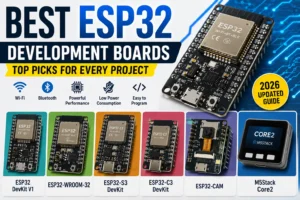
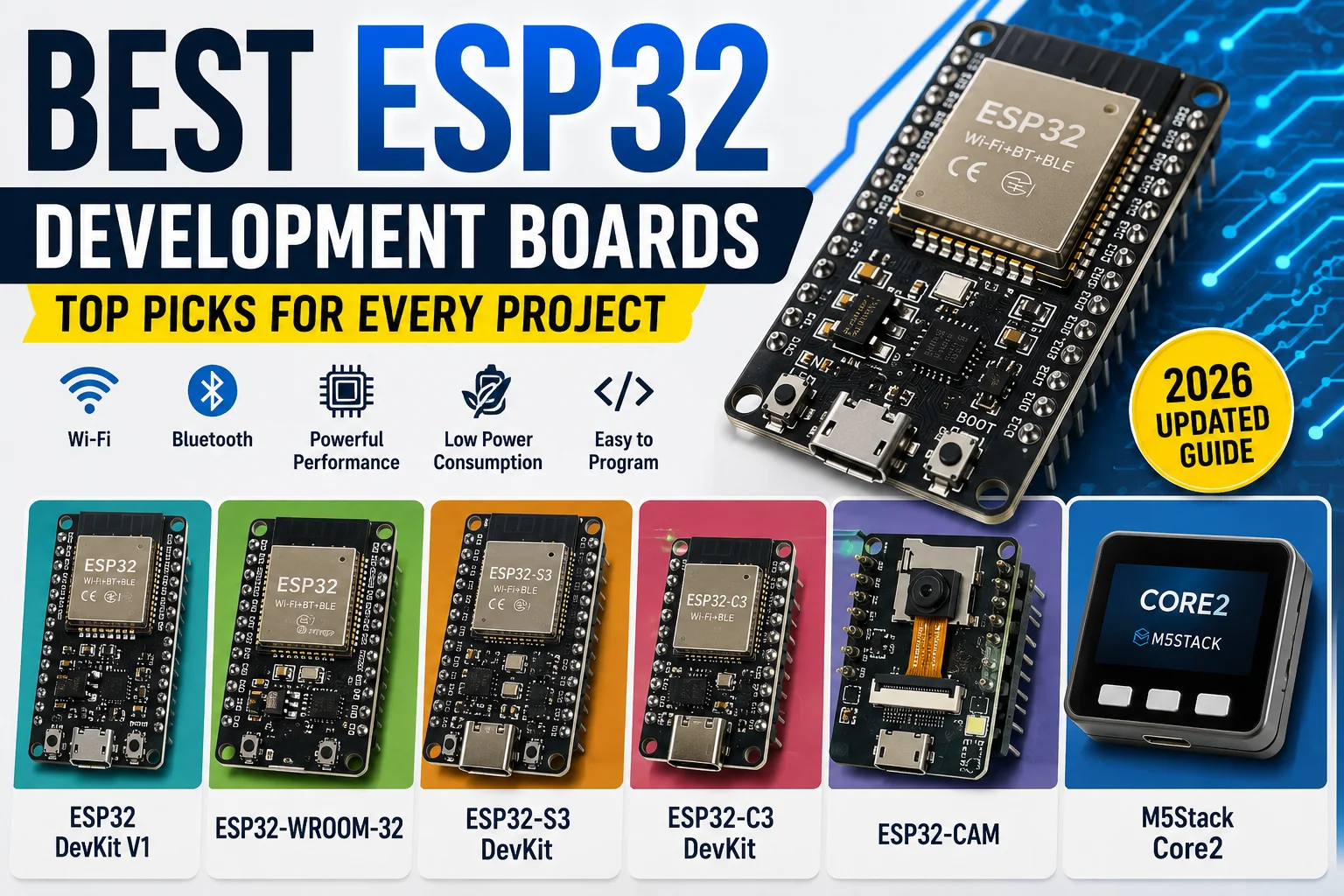
ESP32 development boards have become one of the most popular choices for electronics enthusiasts, students, hobbyists, and professional engineers. Whether you’re building a smart home device, a robot, a weather station, or an industrial IoT system, choosing the right ESP32 board can make your project easier and more efficient.
Although all ESP32 boards belong to the same family, they differ in processing power, memory, wireless capabilities, camera support, USB interface, and intended applications.
This guide compares the best ESP32 development boards available in 2026 and helps you choose the perfect one for your next project.
Why Choosing the Right ESP32 Board Matters
Different ESP32 boards are designed for different purposes.
Some are perfect for:
- Learning embedded programming
- IoT development
- Home automation
- Robotics
- Artificial Intelligence
- Battery-powered devices
- Smart agriculture
- Industrial automation
- Camera-based applications
Choosing the correct board from the beginning saves both time and money.
Beginner & General Purpose ESP32 Boards
| Board | Best For | Key Advantage |
|---|---|---|
| ESP32 DevKit V1 | Beginners and Learning | Affordable with massive community support |
| ESP32-WROOM-32 | General IoT Projects | Stable wireless performance and excellent compatibility |
| ESP32-WROVER | Large Applications | Extra PSRAM for memory-intensive projects |
Advanced ESP32 Boards
| Board | Best For | Key Advantage |
|---|---|---|
| ESP32-S3 DevKit | AI and USB Projects | Better AI performance and native USB support |
| ESP32-C3 DevKit | Budget IoT Devices | Low power consumption with RISC-V processor |
| ESP32-C6 | Future IoT Applications | Supports Wi-Fi 6 for next-generation networking |
Specialized ESP32 Boards
| Board | Best For | Key Advantage |
|---|---|---|
| ESP32-CAM | Smart Camera Projects | Built-in camera interface with Wi-Fi and Bluetooth |
| M5Stack Core2 | Rapid Prototyping | Integrated display, battery, microphone and sensors |
1. ESP32 DevKit V1
Best For
- Beginners
- Students
- Home automation
- Robotics
- Sensor projects
ESP32 DevKit V1 is the most popular ESP32 development board available today. It provides nearly everything needed for learning embedded programming while remaining inexpensive.
It supports Wi-Fi, Bluetooth, multiple GPIO pins, PWM, ADC, and many communication interfaces.
Advantages
- Very affordable
- Huge online community
- Thousands of tutorials
- Compatible with Arduino IDE
- Excellent for learning
Limitations
- Usually uses Micro USB
- No onboard display or sensors
2. ESP32-WROOM-32
Best For
- Professional IoT devices
- Commercial products
- Industrial applications
ESP32-WROOM-32 is the module found on many ESP32 development boards. It offers reliable wireless performance and excellent compatibility with existing ESP32 software libraries.
This module is commonly used in commercial products because of its stability and performance.
Advantages
- Reliable performance
- Good wireless range
- Excellent software support
- Suitable for mass production
Limitations
- Depends on the development board used
- No extra memory compared to WROVER
3. ESP32-WROVER
Best For
- Large applications
- Image processing
- Complex web servers
- Machine learning
The ESP32-WROVER includes additional PSRAM, allowing larger applications and more advanced software.
Projects requiring graphics, web interfaces, or image processing benefit greatly from the additional memory.
Advantages
- Extra PSRAM
- Better for graphics
- Handles large programs easily
Limitations
- Slightly more expensive
- May be unnecessary for simple projects
4. ESP32-S3 DevKit
Best For
- Artificial Intelligence
- TinyML
- Voice recognition
- USB devices
ESP32-S3 is one of the newest and most powerful members of the ESP32 family.
It introduces improved AI acceleration, enhanced USB support, better security, and optimized performance for machine learning applications.
Advantages
- Native USB
- AI acceleration
- Faster processing
- Improved security
Limitations
- Costs more than basic ESP32 boards
- Some older tutorials target the original ESP32
5. ESP32-C3 DevKit
Best For
- Budget IoT devices
- Smart sensors
- Battery-powered products
ESP32-C3 uses the modern RISC-V architecture and focuses on efficiency and affordability.
It is ideal for compact IoT devices that require reliable wireless communication while minimizing power consumption.
Advantages
- Low power consumption
- Cost effective
- Modern RISC-V processor
- Excellent wireless performance
Limitations
- Lower performance than ESP32-S3
- Fewer GPIO pins on some boards
6. ESP32-C6
Best For
- Smart homes
- Industrial IoT
- Future wireless applications
ESP32-C6 introduces Wi-Fi 6 support, making it suitable for next-generation connected devices.
Its improved networking capabilities make it a strong choice for modern IoT deployments.
Advantages
- Wi-Fi 6 support
- Better wireless efficiency
- Future-ready technology
Limitations
- Smaller ecosystem compared to the original ESP32
- Newer platform with fewer tutorials
7. ESP32-CAM
Best For
- Smart security cameras
- Face recognition
- Wildlife monitoring
- Video streaming
- Smart doorbells
ESP32-CAM combines an ESP32 processor with a camera interface and microSD card support.
Despite its low price, it can perform image capture, video streaming, and basic computer vision tasks.
Advantages
- Built-in camera connector
- Supports image processing
- Extremely affordable
Limitations
- Requires an external USB programmer on most versions
- Limited GPIO availability
8. M5Stack Core2
Best For
- Rapid prototyping
- Educational kits
- Industrial dashboards
- Portable IoT devices
Unlike a standard development board, M5Stack Core2 integrates multiple hardware components into one compact device.
It includes:
- Touchscreen
- Rechargeable battery
- Speaker
- Microphone
- Sensors
- Expansion connectors
This allows developers to build prototypes much faster.
Advantages
- All-in-one design
- Professional appearance
- Fast project development
Limitations
- More expensive
- Larger than standard ESP32 boards
Which ESP32 Board Should Beginners Buy?
For beginners, the ESP32 DevKit V1 remains the best choice because it offers:
- Low price
- Easy programming
- Huge community support
- Thousands of online tutorials
- Excellent compatibility with Arduino IDE
It is the board recommended in most beginner guides and YouTube tutorials.
Which ESP32 Board Is Best for IoT?
Recommended boards include:
- ESP32 DevKit V1
- ESP32-WROOM-32
- ESP32-C3
- ESP32-C6
These boards provide excellent wireless performance and are suitable for connected devices.
Which ESP32 Board Is Best for Robotics?
Robotics projects benefit from:
- High processing power
- Plenty of GPIO pins
- Multiple PWM outputs
- Reliable wireless communication
The ESP32 DevKit V1 and ESP32-S3 are among the best options for robotic applications.
Which ESP32 Board Is Best for AI?
For Artificial Intelligence and TinyML applications, the ESP32-S3 DevKit is the top recommendation because of its enhanced processing capabilities and optimized AI instructions.
Things to Consider Before Buying
Before purchasing an ESP32 board, think about:
GPIO Requirements
Ensure the board has enough pins for your sensors and actuators.
Memory
Choose boards with additional PSRAM if your application handles graphics or large datasets.
Wireless Features
Confirm whether your project requires Wi-Fi, Bluetooth Classic, or Bluetooth Low Energy.
USB Connector
Modern boards increasingly use USB Type-C, while older boards commonly feature Micro USB.
Camera Support
If your project involves image capture or video streaming, choose an ESP32-CAM or ESP32-S3-based camera board.
Power Consumption
Battery-operated devices should prioritize efficient boards such as the ESP32-C3.
Advantages of ESP32 Development Boards
- Built-in Wi-Fi
- Bluetooth connectivity
- High performance
- Low cost
- Excellent software ecosystem
- Compatible with Arduino IDE
- Supports ESP-IDF and MicroPython
- Huge online community
- Suitable for both beginners and professionals
Frequently Asked Questions
Which ESP32 board is best for beginners?
ESP32 DevKit V1 is widely regarded as the best beginner board because it is affordable, easy to program, and supported by countless tutorials.
Which ESP32 board is best for AI?
ESP32-S3 DevKit is the preferred option for AI, TinyML, voice recognition, and advanced embedded applications.
Which ESP32 board has a camera?
ESP32-CAM includes a dedicated camera connector and microSD card support for vision-based projects.
Which ESP32 board is best for battery-powered devices?
ESP32-C3 is one of the most power-efficient boards, making it an excellent choice for battery-operated IoT devices.
There is no single “best” ESP32 board for every project. The right choice depends on your specific requirements.
- Best Overall: ESP32 DevKit V1
- Best Value: ESP32-WROOM-32
- Best for AI: ESP32-S3 DevKit
- Best for Camera Projects: ESP32-CAM
- Best Budget Choice: ESP32-C3 DevKit
- Best Future-Proof Option: ESP32-C6
- Best Premium Development Kit: M5Stack Core2
If you’re just getting started with ESP32, the ESP32 DevKit V1 remains the safest and most versatile recommendation.
As your skills grow, you can move to advanced boards like the ESP32-S3 or ESP32-C6 for AI, computer vision, and next-generation IoT applications.