Introduction
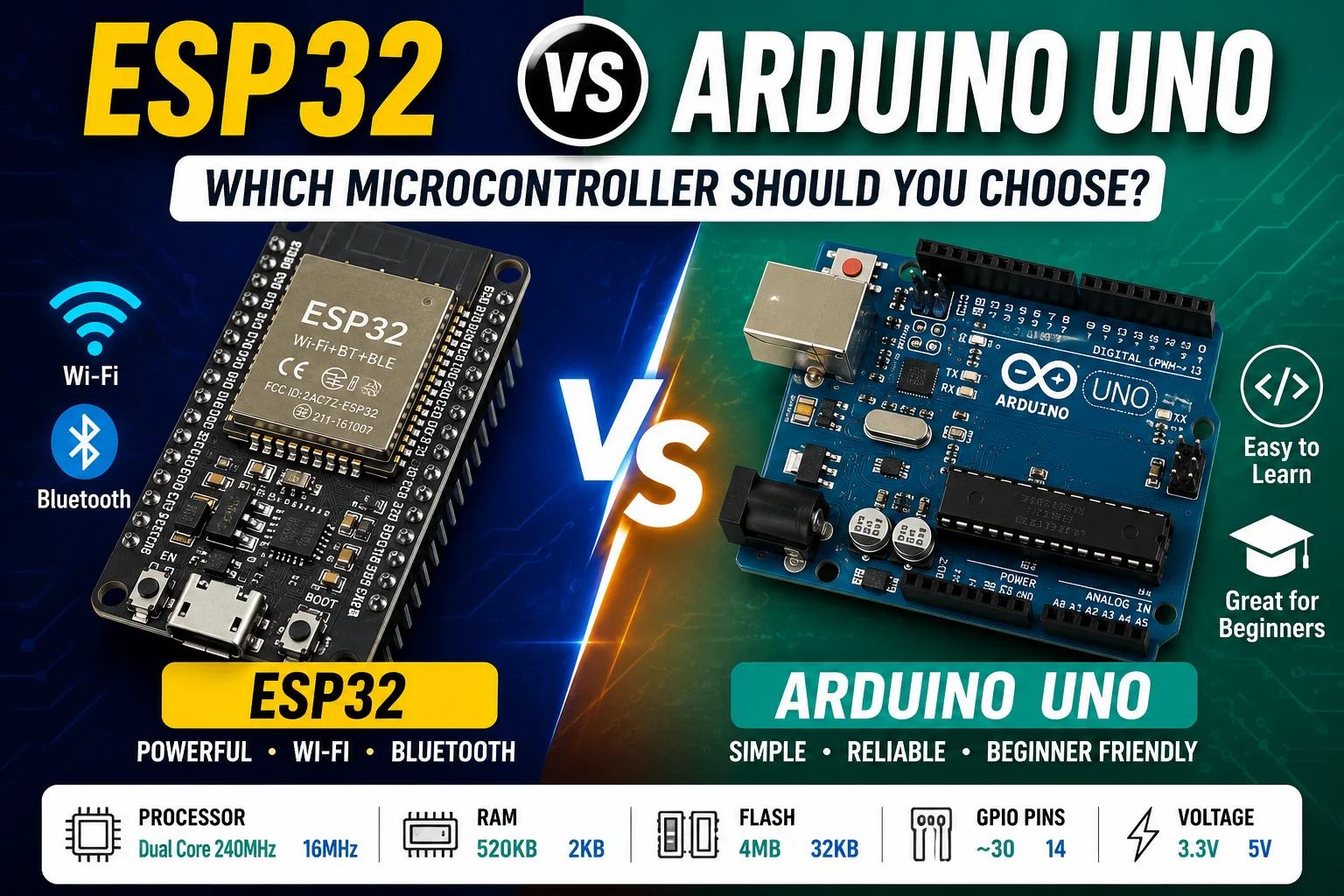
Choosing the right microcontroller is one of the most important decisions when starting an electronics or IoT project. Two of the most popular options are the ESP32 and the Arduino Uno. Both are beginner-friendly and widely supported, but they are designed for different purposes.
The Arduino Uno is an excellent platform for learning basic electronics and programming, while the ESP32 is a powerful modern microcontroller with built-in Wi-Fi and Bluetooth, making it ideal for Internet of Things (IoT) applications.
In this guide, we’ll compare ESP32 and Arduino Uno in detail, covering their specifications, performance, connectivity, power consumption, programming, advantages, disadvantages, and ideal use cases.
What Is ESP32?
ESP32 is a 32-bit microcontroller developed by Espressif Systems. It integrates Wi-Fi and Bluetooth on the same chip, allowing developers to build wireless and IoT projects without additional communication modules.
Its powerful processor, large memory, and advanced peripherals make it suitable for everything from home automation to industrial monitoring systems.
What Is Arduino Uno?
Arduino Uno is one of the world’s most popular development boards. It is based on the ATmega328P microcontroller and is designed primarily for beginners learning electronics and embedded programming.
Unlike ESP32, Arduino Uno does not include built-in Wi-Fi or Bluetooth, but its simplicity makes it an excellent learning platform.
ESP32 vs Arduino Uno: Quick Comparison
| Feature | ESP32 | Arduino Uno |
|---|---|---|
| Processor | 32-bit Dual-Core | 8-bit Single-Core |
| Clock Speed | Up to 240 MHz | 16 MHz |
| Built-in Wi-Fi | Yes | No |
| Bluetooth | Yes (Classic + BLE) | No |
| GPIO Pins | Around 30 usable | 14 Digital |
| Analog Inputs | Multiple ADC Channels | 6 ADC Channels |
| DAC Output | Yes | No |
| PWM Outputs | Multiple | 6 |
| RAM | Much Higher | 2 KB SRAM |
| Flash Memory | Usually 4 MB | 32 KB |
| USB Programming | Yes | Yes |
| Typical Applications | IoT, Automation, Robotics | Education, Basic Electronics |
Processor Performance
The ESP32 is significantly more powerful than the Arduino Uno.
Its dual-core processor can perform multiple tasks simultaneously, such as running a web server while reading sensors and controlling motors.
Arduino Uno uses a simple 8-bit processor that works well for small standalone projects but struggles with complex multitasking.
Winner: ESP32
Wireless Connectivity
This is where the biggest difference appears.
ESP32 includes:
- Built-in Wi-Fi
- Bluetooth Classic
- Bluetooth Low Energy (BLE)
Arduino Uno has no wireless communication built in. To connect it to Wi-Fi or Bluetooth, additional modules must be purchased and connected.
If your project requires internet connectivity, ESP32 is the clear choice.
Winner: ESP32
Memory
Modern IoT applications require larger memory for storing code, web pages, sensor data, and communication libraries.
ESP32 offers:
- Much larger Flash memory
- Significantly more RAM
- Better support for large applications
Arduino Uno has limited memory, which can become a constraint as projects grow.
Winner: ESP32
GPIO and Peripheral Support
Both boards provide digital and analog input/output pins.
ESP32 additionally supports:
- Capacitive touch sensors
- DAC outputs
- Multiple UART ports
- Multiple SPI interfaces
- Multiple I2C buses
- CAN interface (on supported variants)
- High-resolution PWM
Arduino Uno provides enough I/O for basic projects but fewer advanced peripherals.
Winner: ESP32
Ease of Learning
Arduino Uno has been the preferred learning platform for years.
Reasons include:
- Simple architecture
- Easy-to-understand examples
- Extensive beginner tutorials
- Minimal configuration
ESP32 is also beginner-friendly but introduces concepts such as Wi-Fi, Bluetooth, multitasking, and more advanced pin assignments.
For someone completely new to electronics, Arduino Uno can be slightly easier to understand.
Winner: Arduino Uno
Programming
Both boards can be programmed using the Arduino IDE.
ESP32 also supports:
- ESP-IDF
- PlatformIO
- MicroPython
This gives developers greater flexibility as their projects become more advanced.
Power Consumption
For battery-powered IoT devices, ESP32 offers advanced sleep modes that dramatically reduce power usage when idle.
Arduino Uno generally consumes more power in standard operation and lacks the sophisticated low-power features available on ESP32.
For long-term battery applications, ESP32 is usually the better choice when deep sleep is used correctly.
Winner: ESP32
Cost
Prices vary depending on the board manufacturer.
In many markets:
- Arduino Uno boards are affordable.
- ESP32 development boards are often available at a similar price while offering many more features.
This makes ESP32 one of the best value-for-money microcontrollers available today.
Best Applications for ESP32
ESP32 is ideal for:
- Smart home automation
- IoT devices
- Wireless sensor networks
- Robotics
- Remote monitoring
- GPS tracking
- Smart agriculture
- Industrial automation
- Web servers
- Bluetooth devices
- Data logging
- Smart energy monitoring
Best Applications for Arduino Uno
Arduino Uno remains an excellent choice for:
- Learning embedded programming
- School and college projects
- LED experiments
- Motor control basics
- Sensor interfacing
- Educational robotics
- Electronic prototypes
- Beginner electronics courses
Advantages of ESP32
- Built-in Wi-Fi
- Built-in Bluetooth
- High processing speed
- Large memory
- Low power modes
- Excellent value for money
- Supports advanced IoT applications
- Large developer community
Disadvantages of ESP32
- Slightly steeper learning curve
- More complex pin configuration
- Higher power usage when Wi-Fi is active
Advantages of Arduino Uno
- Extremely beginner-friendly
- Massive educational ecosystem
- Stable and reliable
- Easy hardware interfacing
- Countless example projects
- Ideal for learning programming
Disadvantages of Arduino Uno
- No Wi-Fi
- No Bluetooth
- Limited memory
- Slower processor
- Less suitable for modern IoT applications
Which One Should You Choose?
Choose ESP32 if you plan to build:
- IoT projects
- Home automation
- Smart farming systems
- Wireless sensors
- Remote monitoring devices
- Robotics with internet connectivity
- Commercial connected products
Choose Arduino Uno if you want to:
- Learn electronics from scratch
- Understand microcontroller basics
- Build simple educational projects
- Experiment with sensors and LEDs
- Study embedded programming fundamentals
Frequently Asked Questions
Is ESP32 better than Arduino Uno?
For most modern projects, yes. ESP32 provides significantly better performance, built-in wireless communication, more memory, and advanced peripherals. However, Arduino Uno is still an excellent learning platform for beginners.
Can ESP32 replace Arduino Uno?
In many projects, yes. Since ESP32 can also be programmed using the Arduino IDE, it can perform most tasks that Arduino Uno handles while offering many additional features.
Is Arduino Uno obsolete?
No. Arduino Uno continues to be widely used in education, prototyping, and beginner electronics because of its simplicity and extensive learning resources.
Which board is better for IoT?
ESP32 is specifically designed for IoT applications thanks to its integrated Wi-Fi and Bluetooth connectivity.
Both ESP32 and Arduino Uno are excellent microcontrollers, but they target different audiences. Arduino Uno remains one of the best boards for learning the fundamentals of embedded systems, while ESP32 is the better choice for modern connected applications.
If you’re starting with projects that involve wireless communication, cloud connectivity, smart homes, or automation, ESP32 offers far more capabilities without a significant increase in cost. For most makers and developers in 2026, ESP32 provides the best balance of performance, features, and value.