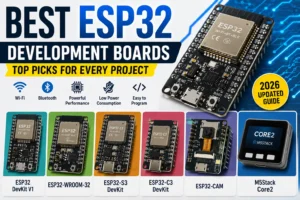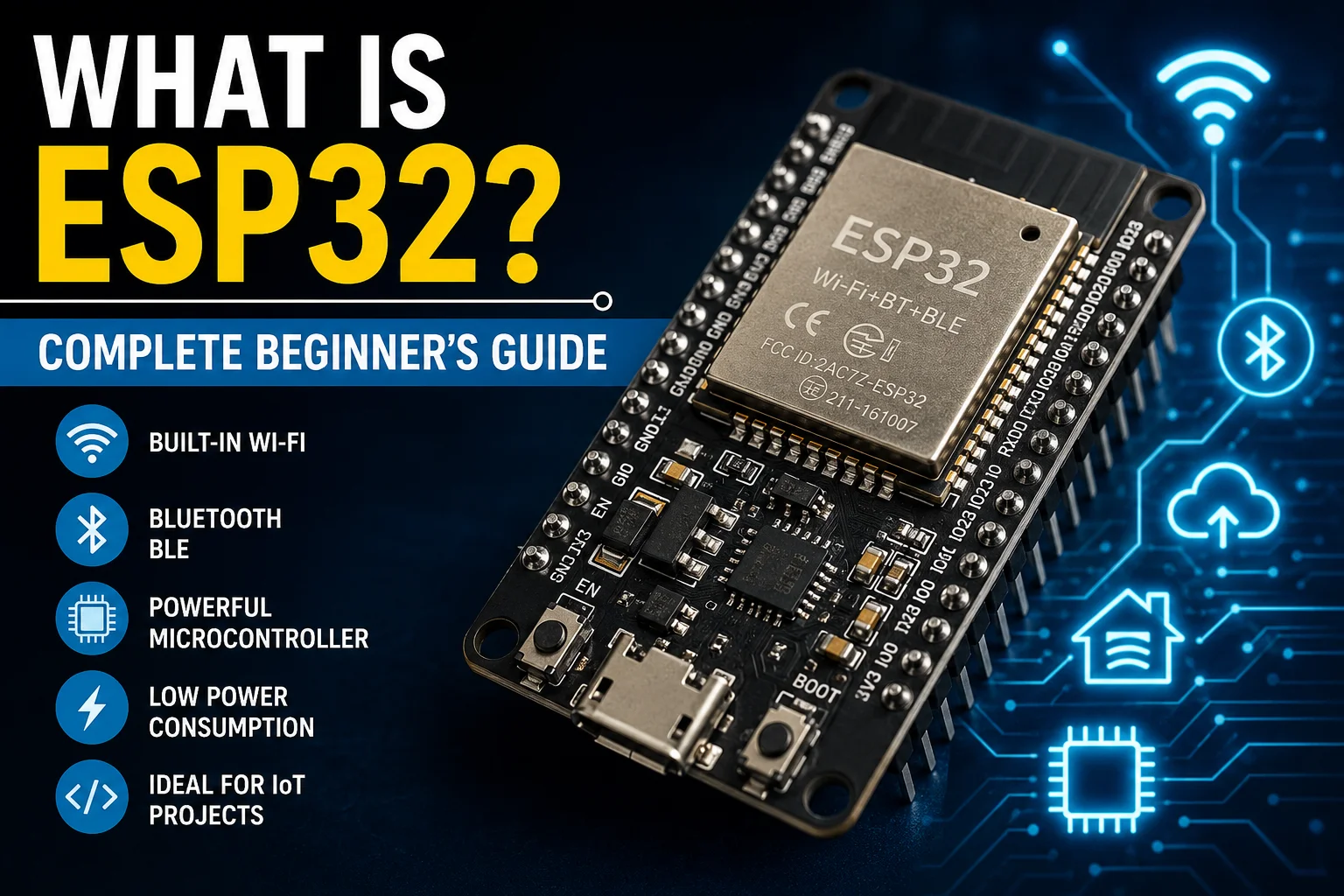
ESP32 is one of the most popular microcontrollers used for Internet of Things (IoT), home automation, robotics, industrial automation, and smart electronic projects. It combines a powerful processor, built-in Wi-Fi, Bluetooth, multiple input/output pins, and low power consumption into a single, affordable chip.
Whether you are a beginner learning electronics or an experienced developer building commercial products, ESP32 provides an excellent balance of performance, features, and cost.
In this guide, you’ll learn everything you need to know about ESP32, including its features, working principle, applications, advantages, disadvantages, and why it has become the preferred choice for millions of makers worldwide.
What Is ESP32?
ESP32 is a low-cost, low-power microcontroller developed by Espressif Systems. It is designed to connect electronic devices to the internet while also controlling sensors, motors, displays, relays, and many other hardware components.
Unlike traditional microcontrollers, ESP32 includes built-in Wi-Fi and Bluetooth connectivity, eliminating the need for separate communication modules in many projects.
Simply put, ESP32 acts as the brain of an electronic system. It reads information from sensors, processes the data, and controls output devices according to the programmed logic.
Why Is ESP32 So Popular?
ESP32 became extremely popular because it offers features that previously required several separate components.
Some of its biggest advantages include:
- Built-in Wi-Fi
- Bluetooth Classic support
- Bluetooth Low Energy (BLE)
- Fast dual-core processor
- Large number of GPIO pins
- ADC and DAC functionality
- PWM outputs
- Capacitive touch sensing
- Multiple communication protocols
- Deep sleep power-saving modes
- Affordable price
This combination makes ESP32 suitable for thousands of different applications.
Key Features of ESP32
Powerful Processor
Most ESP32 variants feature a dual-core 32-bit processor capable of running multiple tasks simultaneously.
This allows one core to manage Wi-Fi communication while the other controls sensors or performs calculations.
Built-in Wi-Fi
One of ESP32’s biggest strengths is integrated Wi-Fi.
It can:
- Connect to home Wi-Fi networks
- Create its own Wi-Fi hotspot
- Host web servers
- Send data to cloud platforms
- Control devices remotely
This eliminates the need for additional Wi-Fi modules.
Bluetooth Connectivity
ESP32 supports both:
- Bluetooth Classic
- Bluetooth Low Energy (BLE)
This enables communication with smartphones, tablets, laptops, smartwatches, and other Bluetooth devices.
Multiple GPIO Pins
GPIO stands for General Purpose Input Output.
These pins allow ESP32 to communicate with external hardware such as:
- LEDs
- Switches
- Buttons
- Relays
- Motors
- Displays
- Sensors
- Buzzers
Analog Inputs
ESP32 can measure analog voltages using built-in Analog-to-Digital Converters (ADC).
This makes it suitable for reading:
- Temperature sensors
- Light sensors
- Gas sensors
- Potentiometers
- Moisture sensors
Analog Outputs
Many ESP32 boards include Digital-to-Analog Converter (DAC) outputs.
These can generate analog voltage signals useful in audio and control applications.
PWM Outputs
Pulse Width Modulation (PWM) allows ESP32 to control:
- LED brightness
- Fan speed
- Motor speed
- Servo motors
without requiring additional hardware.
Capacitive Touch Sensors
ESP32 includes built-in touch sensing capability.
You can create touch buttons simply by connecting conductive metal pads without mechanical switches.
Deep Sleep Mode
ESP32 is optimized for battery-powered devices.
During deep sleep mode, it consumes extremely little power while retaining essential functions.
This is ideal for:
- Weather stations
- Remote sensors
- Battery-operated IoT devices
- Wildlife monitoring systems
How Does ESP32 Work?
ESP32 continuously performs three basic operations:
1. Reads Inputs
It collects information from sensors such as:
- Temperature
- Humidity
- Motion
- Pressure
- Distance
- Water level
2. Processes Data
The processor executes the uploaded program and makes logical decisions.
For example:
“If temperature exceeds 35°C, turn ON the cooling fan.”
3. Controls Outputs
Based on the programmed logic, ESP32 controls devices like:
- Relays
- Motors
- LEDs
- Displays
- Buzzers
- Pumps
- Solenoid valves
This process repeats thousands of times every second.
Common Applications of ESP32
ESP32 is used in countless projects across different industries.
Popular applications include:
- Smart home automation
- Smart lighting systems
- Weather stations
- Security systems
- Attendance systems
- Smart irrigation
- Industrial automation
- IoT devices
- Wireless sensor networks
- Smart agriculture
- GPS trackers
- Energy monitoring
- Robotics
- Remote monitoring
- Wireless data logging
- Home appliances
- Smart locks
- Environmental monitoring
Programming ESP32
ESP32 supports several programming environments.
The most popular are:
- Arduino IDE
- PlatformIO
- ESP-IDF
- MicroPython
Beginners often start with Arduino IDE because of its simple interface and extensive community support.
Professional developers frequently use ESP-IDF for advanced features and maximum performance.
Advantages of ESP32
ESP32 offers numerous benefits compared to many traditional microcontrollers.
Excellent Performance
Its fast processor handles complex tasks with ease.
Wireless Connectivity
Integrated Wi-Fi and Bluetooth reduce hardware complexity.
Cost Effective
ESP32 boards are inexpensive while offering premium features.
Low Power Consumption
Deep sleep modes allow long battery life.
Large Community Support
Millions of users contribute tutorials, libraries, and example projects.
Wide Sensor Compatibility
ESP32 works with hundreds of sensors and modules available in the market.
Flexible Communication
Supports multiple communication interfaces including:
- UART
- SPI
- I2C
- I2S
- CAN
- PWM
Limitations of ESP32
Although powerful, ESP32 also has some limitations.
- Limited RAM compared to full computers
- Not suitable for heavy image processing
- Some GPIO pins have special boot functions
- Beginners may initially find pin configuration confusing
- Real-time applications require careful programming
Despite these limitations, ESP32 remains one of the best microcontrollers for most embedded projects.
Who Should Use ESP32?
ESP32 is ideal for:
- Students
- Electronics hobbyists
- IoT developers
- Robotics enthusiasts
- Embedded engineers
- Home automation developers
- Industrial automation designers
- Agriculture automation projects
- Product developers
- Startups building connected devices
Future of ESP32
The popularity of ESP32 continues to grow as more devices become internet-connected.
Modern applications now include:
- Artificial Intelligence at the edge
- Voice assistants
- Smart factories
- Smart farming
- Predictive maintenance
- Remote healthcare devices
- Energy-efficient buildings
- Connected vehicles
With ongoing improvements from Espressif and an active global community, ESP32 is expected to remain one of the leading microcontroller platforms for years to come.
Frequently Asked Questions
Is ESP32 better than Arduino?
ESP32 is generally more powerful than many traditional Arduino boards because it includes a faster processor, built-in Wi-Fi, Bluetooth, and more advanced peripherals. However, Arduino boards remain an excellent choice for simple beginner projects.
Can ESP32 work without Wi-Fi?
Yes. ESP32 can operate completely offline and control sensors, motors, displays, and other devices without an internet connection.
Is ESP32 good for beginners?
Yes. With the Arduino IDE and the vast number of tutorials available, ESP32 is an excellent platform for learning embedded systems and IoT development.
Can ESP32 run on batteries?
Yes. Thanks to its low-power sleep modes, ESP32 is well suited for battery-powered devices that wake up periodically to collect or transmit data.
Is ESP32 suitable for commercial products?
Yes. Many commercial IoT products, smart appliances, and industrial devices are built around ESP32 due to its combination of performance, wireless connectivity, and affordability.
ESP32 has transformed the world of embedded electronics by combining powerful processing, built-in wireless connectivity, and versatile hardware interfaces into a compact and affordable platform. From simple LED projects to sophisticated IoT systems, it provides the flexibility needed for beginners and professionals alike.
If you are planning to learn electronics, build smart devices, or develop connected products, ESP32 is one of the best microcontrollers to start with. Its extensive ecosystem, strong community support, and wide range of applications make it a future-ready platform for innovation.